I procrastinated for nearly two weeks before installing Microsoft's new Web browser.
I'd been happy using rival products like Firefox and Chrome at work and Flock at home, and habits are hard to break, even though version eight of Internet Explorer, or IE8, has several promising features.
In essence, all browsers have gotten so good at delivering the basics that I find little reason to change. The frills are what set each browser apart, but getting unique offerings in one means giving up features in another. However thrilling IE8's new offerings may be, I'm not ready to give up Flock, Firefox or Chrome just yet.
Still, Microsoft should be applauded for trying.
Hit the Accelerator
Most notable in Microsoft's free, Windows-only browser are tools called "Accelerators," which are designed to better mirror how people use the Web these days. Accelerators help you share content and blend services from various sites.
You can install Accelerators written by Microsoft, Yahoo , Google , Facebook or any developer that wants to participate -- no one needs permission from Microsoft.
With a mapping Accelerator, I simply right-click on an address to launch an online map from Microsoft, Yahoo or Google. With a dictionary Accelerator, I right-click on a word to get the definition from Dictionary.com, Urban Dictionary or Microsoft's search engine.
There are Accelerators for email, news stories, currency conversions, eBay auctions, searching through Facebook friends, and more. This week, I counted more than 110 available through Microsoft's "Add-ons Gallery."
I can save a lot of time by not having to constantly copy and paste text from online stories into Gmail when I want to email the tidbits to friends. I simply highlight a few paragraphs and right-click on the Gmail Accelerator. Those paragraphs and a link to the full story automatically get added to the message. Accelerators are also available for email services from Microsoft and Time Warner's AOL.
By Comparison
IE8 also offers "Web Slices" to quickly alert users to updates on their eBay auctions, stock quotes, sports scores and other frequently viewed services. They appear on your favorites bar just like other bookmarks, but instead of static pages or text headlines, you get the latest photos and other goodies as well.
The new Microsoft browser also makes it easier to switch between search engines from the search box. It offers a "private" mode during which IE8 doesn't store the addresses of sites you visit or keep the small advertising data files called "cookies."
However, to use any of that, I'd have to give up one of my favorite things about Flock: the way it helps people share content and blend services.
On Flock, a Web clipboard lets me quickly drag and drop frequently used images and text, such as the Web coding I regularly add to my photo site to create links. A people sidebar lets me instantly see friends' Facebook updates, even when I'm surfing other sites.
Both Firefox and Flock let me quickly find information with an "Awesome Bar" that offers suggestions as I type, based not only on previously visited Web addresses but also the Web page's title, bookmarks and the descriptive tags I've added. Microsoft's new address bar is an improvement from previous versions but doesn't go as far.
Google's Chrome, which has a private browsing mode similar to IE8's, lets me enter search queries and Web addresses from a single box, so I don't have to pause before typing to remind myself which one to use.
Sunday, April 5, 2009
Saturday, April 4, 2009
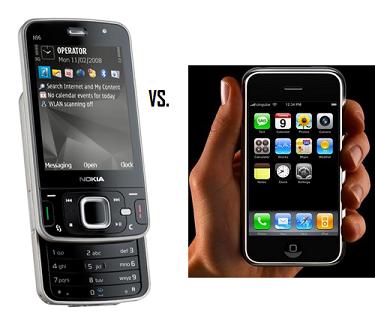
Clash of the Titans!!!
Price Comparision:
The Nokia N96 will cost you around Rs. 36,000 while the Apple iPhone 3G with 8GB memory will cost Rs. 31000 and 16GB about Rs. 36,100. On price points even though they are hugely expensive we give them equal rank.
SMS Forwarding, FM Radio:
These two features are the darling of any mobile phone user in India. Since Texting messaging is really cheap in this part of the world forwarding SMSes is a very normal thing for all users. FM Radio is the life of people whilst traveling this is your one source of entertainment on the roads of the Indian metro cities. The lack of both these features on the iPhone is a big minus as far as its Indian market is concerned.
Battery Life:
Nokia N96 wins on this hands down. There have been lots of problems with the battery drainage of the Apple iPhone and these don't seem to stop. You will have to charge your phone everyday or twice a day for that matter if you are a heavy user.
GPS:
This is not a huge factor for the Indian market, but still a talking point. On the GPS front Nokia again wins this pretty easily.
Video Calling:
Video calling is not possible on the iPhone and the Nokia N96 is pretty good at it.
Data Transfer and Bluetooth usage:
A major , major talking point regarding the iPhone. The bluetooth on the iPhone can only be used for hands-free calling. No data transfer allowed between handsets or even with a computer with bluetooth enabled.Storage:
You thought the storage factor will play in for the iPhone ? That isn't true. The Nokia N96 comes with 16GB of internal storage plus you have the luxury of adding a 8GB memory card giving you a whopping storage of 24GB. The iPhone again loses here.
Design:
There is no beating the iPhone, as simple as that!
All in all, if you are looking for more bang for the buck, go for the Nokia N96. Lookwise and as a fashion symbol, we still say there is no beating the iPhone!
Google Here,Google There,Google Google Everywhere
Google declined to discuss the issue. "We don't comment on rumor or speculation," Google spokesperson Rachel Nearnberg told the E-Commerce Times.
Twitter cofounder Biz Stone ducked the issue, telling the E-Commerce Times that he'd already addressed it on the company blog. "Our goal is to build a profitable, independent company and we're just getting started," he says in a post.
Though it's managed to kick up a lot of publicity and attract many users, Twitter has yet to make money. Still, it's growing rapidly, and there has long been speculation that its backers are pressing it to turn a buck or two.
Hungry Eyes
Two people close to the situation said Google is in late-stage negotiations to acquire Twitter and that the price will be more than the US$250 million valuation Twitter saw in its latest round of funding in February, according to the TechCrunch report.
That's not going to happen, Greg Sterling, founding principal of Sterling Market Intelligence, told the E-Commerce Times. "On 'The Colbert Report,' Biz Stone talked about expanding Twitter and growing it to a global network," Sterling said. "He also said he wants Twitter to be a strong, independent company."
For example, YouTube has more searches than Yahoo does, Sterling said. "That kind of thing is what Google would look to pre-empt."
On Thursday, Twitter announced new features and adjustments it's making to its search capabilities.
Researchers Trace International Cyber-Spy Network to China
A cyber spy network based mainly in China hacked into classified documents from government and private organizations in 103 countries, including the computers of the Dalai Lama and Tibetan exiles, Canadian researchers said Saturday.
The work of the Information Warfare Monitor initially focused on allegations of Chinese cyber espionage against the Tibetan community in exile, and eventually led to a much wider network of compromised machines, the Internet-based research group said.
"We uncovered real-time evidence of malware that had penetrated Tibetan computer systems, extracting sensitive documents from the private office of the Dalai Lama," investigator Greg Walton said.
Can't Pinpoint Source
The research group said that while it's analysis points to China as the main source of the network, it has not conclusively been able to detect the identity or motivation of the hackers.
Calls to China's Foreign Ministry and Industry and Information Ministry rang unanswered Sunday. The Chinese Embassy in Toronto did not immediately return calls for comment Saturday.
Students For a Free Tibet activist Bhutila Karpoche said her organization's computers have been hacked into numerous times over the past four or five years, and particularly in the past year. She said she often gets e-mails that contain viruses that crash the group's computers.
The IWM is composed of researchers from Ottawa-based think tank SecDev Group and the University of Toronto's Munk Centre for International Studies. The group's initial findings led to a 10-month investigation summarized in the report to be released online Sunday.
No Stopping Android
HP has confirmed it is considering Google's Android operating system for use in upcoming netbook computers.
However, the company has not set a time line for deciding whether to offer Android exclusively or as one of several OS options for its products, if at all, according to Marlene Somsak, an HP spokesperson.
"We are studying Android. We want to assess its capabilities," she told LinuxInsider.
If HP decides in favor of using Android, it could well become the first major PC vendor to use Google's OS, currently deployed in smartphones.
Microsoft Waiting
Microsoft's Windows operating system has had steady competition from various Linux distributions in the netbook line. Because Windows Vista is usually too bulky for the limited memory and storage capacity of many netbook models, Microsoft XP has been the designated OS for non-Linux netbooks.
However, Microsoft has said that it is preparing a version of Windows 7 to be compatible with netbook configurations. Windows 7 is expected to be released later this year after a strong showing in its beta release.
Microsoft suggested to LinuxInsider that it did not view HP's consideration of the Android OS as a threat to the Windows OS on netbooks.
"This has long been a competitive space," Ben Rudolph, senior manager of Microsoft Windows, told LinuxInsider. "We've seen Windows on these PCs in the U.S. go from under 10 percent in unit sales during the first half of 2008 to 96 percent as of February 2009, according to the latest NPD Retail Tracking Service data,"
Microsoft remains confident that Windows' out-of-the-box functionality will ensure its continuing popularity in netbooks, he said.
"The return rates for Linux machines are up to four times higher than Windows return rates. This is a significant additional cost for consumers and retailers," Rudolph explai
However, the company has not set a time line for deciding whether to offer Android exclusively or as one of several OS options for its products, if at all, according to Marlene Somsak, an HP spokesperson.
"We are studying Android. We want to assess its capabilities," she told LinuxInsider.
If HP decides in favor of using Android, it could well become the first major PC vendor to use Google's OS, currently deployed in smartphones.
Microsoft Waiting
Microsoft's Windows operating system has had steady competition from various Linux distributions in the netbook line. Because Windows Vista is usually too bulky for the limited memory and storage capacity of many netbook models, Microsoft XP has been the designated OS for non-Linux netbooks.
However, Microsoft has said that it is preparing a version of Windows 7 to be compatible with netbook configurations. Windows 7 is expected to be released later this year after a strong showing in its beta release.
Microsoft suggested to LinuxInsider that it did not view HP's consideration of the Android OS as a threat to the Windows OS on netbooks.
"This has long been a competitive space," Ben Rudolph, senior manager of Microsoft Windows, told LinuxInsider. "We've seen Windows on these PCs in the U.S. go from under 10 percent in unit sales during the first half of 2008 to 96 percent as of February 2009, according to the latest NPD Retail Tracking Service data,"
Microsoft remains confident that Windows' out-of-the-box functionality will ensure its continuing popularity in netbooks, he said.
"The return rates for Linux machines are up to four times higher than Windows return rates. This is a significant additional cost for consumers and retailers," Rudolph explai
RIM Cuts Ribbon on BlackBerry App Store
BlackBerry maker Research In Motion has launched an app store for its iconic device. BlackBerry App World went live Wednesday morning with some 1,000 applications available.
The site gives developers the option of setting up their own stores -- an interesting differentiator from other carriers' app stores, noted ABI Research Senior Analyst Jeff Orr.
A storefront application, App Center, lets developers pull content from App World to add alongside their own content, he told the E-Commerce Times.
Among the applications currently available are Salesforce CRM , AOL Instant Messenger, Yahoo Messenger, MySpace, Facebook, Windows Live Messenger, Bloomberg, ICQ, HRS Hotel Organizer, chat group VH1 Watch and Discuss, Lonely Planet French Phrasebook, Livestrong, Worldmate Live, Brain Challenge 2, and a few news and media applications such as a Web shortcut to the New York Times.
BlackBerry App World works with compatible BlackBerry smartphones running OS version 4.2.0 or higher, including the Bold 9000; the Storm; both the Pearl Series and Pearl Flip Series; the Curve 8300 Series; Curve 8900; and the 8800 Series. Trackwheel devices are not supported.
The site gives developers the option of setting up their own stores -- an interesting differentiator from other carriers' app stores, noted ABI Research Senior Analyst Jeff Orr.
A storefront application, App Center, lets developers pull content from App World to add alongside their own content, he told the E-Commerce Times.
Among the applications currently available are Salesforce CRM , AOL Instant Messenger, Yahoo Messenger, MySpace, Facebook, Windows Live Messenger, Bloomberg, ICQ, HRS Hotel Organizer, chat group VH1 Watch and Discuss, Lonely Planet French Phrasebook, Livestrong, Worldmate Live, Brain Challenge 2, and a few news and media applications such as a Web shortcut to the New York Times.
BlackBerry App World works with compatible BlackBerry smartphones running OS version 4.2.0 or higher, including the Bold 9000; the Storm; both the Pearl Series and Pearl Flip Series; the Curve 8300 Series; Curve 8900; and the 8800 Series. Trackwheel devices are not supported.
Yahoo Launches New Mobile User-App
Yahoo on Wednesday rolled out its new Yahoo Mobile service for smartphones. The company also announced Yahoo Messenger for the iPhone, which will be launched soon. Yahoo Mobile for the Web is available as a service on the mobile Web, accessible by cell phones with Web browsers. It's also available at Apple's (Nasdaq: AAPL) App Store for the iPhone and the iPod touch, Yahoo spokesperson Kate Sternberg told TechNewsWorld. The mobile service can be accessed on more than 300 devices equipped with mobile browsers, Yahoo said. These include smartphones from Nokia, Research In Motion, Samsung, Sony Ericsson and Motorola, as well as Windows Mobile devices. Users of Yahoo Mobile for the Web will have access to mobile search; news; oneConnect to stay in touch with contacts; email services from Yahoo, Google, AOL and Microsoft; social networking sites including Twitter and Facebook; and Yahoo's address book, calendar and instant messaging service. The Java smartphone version of Yahoo Mobile for the Web has additional features. These include voice-controlled search capabilities; access to maps; widgets for services from Yahoo and other brands that can be browsed, added or removed at any time; and an integrated version of the Opera Mini 4.2 browser.
Subscribe to:
Posts (Atom)